Continuity, presence, discretion: three ways
to design the washbasin
From the continuous top to the countertop volume, up to the discretion of recessed installation: the washbasin becomes a design choice that guides style, proportions and use of the bathroom space.
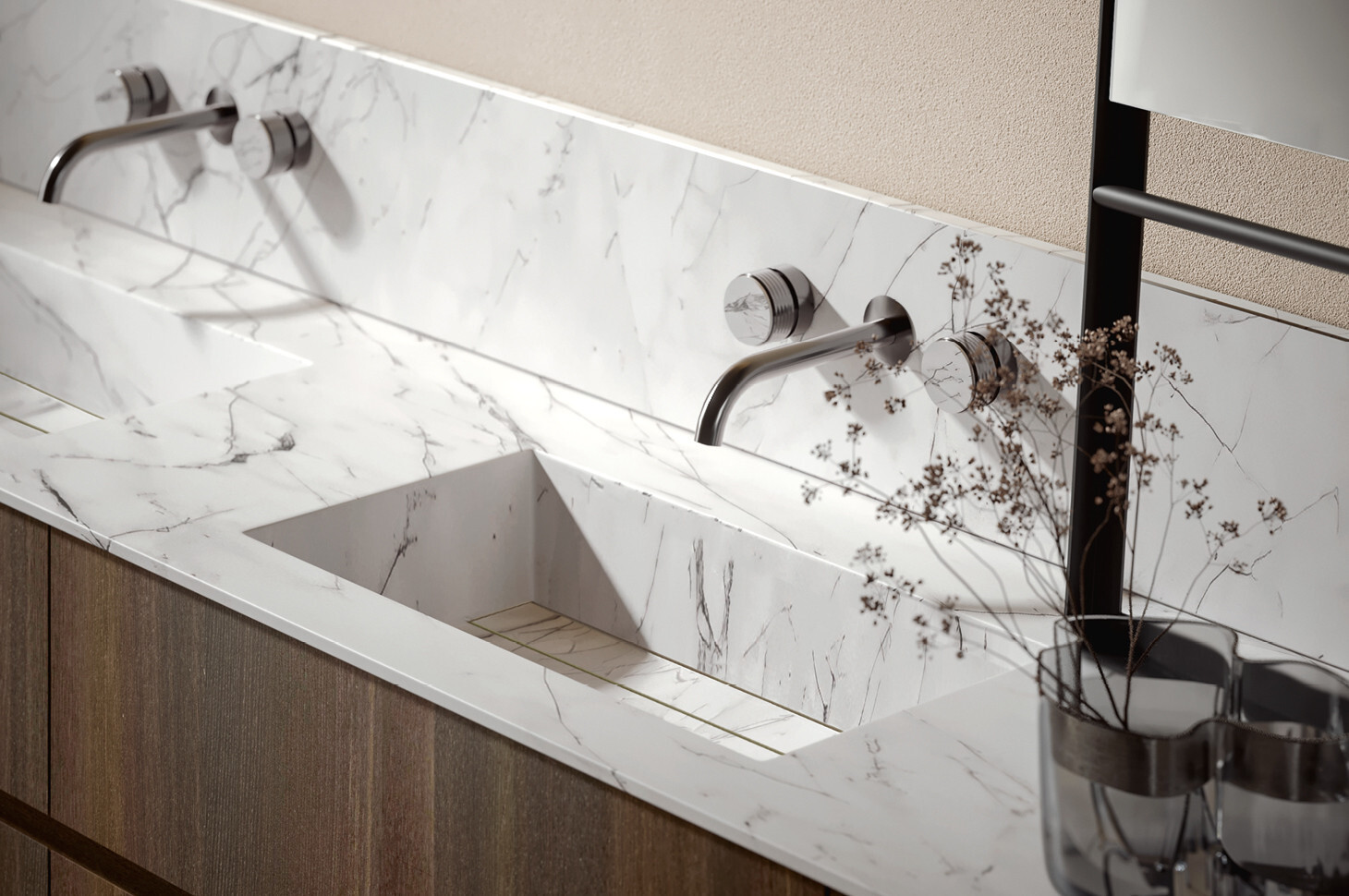
In the bathroom project, the washbasin is never an isolated element. It is the point where everyday function meets the design of the furniture, the material of the top, the available depth and the visual hierarchy of the composition. Depending on the type chosen, it can blend into the surface, emerge as an autonomous volume or recede until it almost disappears, substantially changing the reading of the entire environment.
For this reason, talking about the washbasin means talking about proportions, supports, solids and voids, continuity and focal points. The choice does not concern form, material or size alone, but the role the washbasin takes within the whole: it can make the top more fluid, give strength to the washbasin wall, lighten the composition or resolve depth constraints. Continuity, presence and discretion thus become three keys for reading and building the project.
Continuity: when the washbasin becomes part of the top
Choosing an integrated washbasin means working on a continuous surface, where basin and top belong to the same design. The composition appears more compact, the top maintains a fluid reading and the furniture can be perceived as a single volume, without evident interruptions between function and storage. It is a solution that enhances the cleanliness of the lines and brings out the relationship between fronts, sides, depth and finishes.
Integrated basins — such as Venere, Atlas, Ares and many others — allow this direction to be interpreted through different registers, more essential or more material depending on the context. Their design value lies in the ability not to impose themselves as separate objects, but to accompany the top, making the washbasin area ordered, measured and perfectly consistent with the overall design.
Presence: when shape defines style
The countertop washbasin introduces a different hierarchy. In this case, the basin rests on the top as an autonomous volume and becomes one of the elements that most immediately defines the character of the composition. Shape influences style: a round profile can soften the geometry of the furniture, an oval proportion can visually extend the top, a fuller volume can give material strength to the whole, while a sharper outline can introduce a graphic and recognisable sign.
Countertop basins — such as Apollo, Elea, Scudo and many others — therefore become visual references capable of guiding the project without the need to describe it didactically.
Recessed installation: the edge as a detail, subtraction as a design choice
Recessed installation introduces an intermediate approach between continuity and presence. With a recessed overcounter basin, the bowl is almost entirely integrated into the top, leaving only the edge visible: a subtle detail, yet enough to define the relationship between the washbasin and the surface. With an undercounter basin, the opposite happens: the washbasin recedes, the bowl disappears from the front view and the top takes centre stage.
These are two different ways of working with subtraction, particularly suited to projects that seek balance, precision and a quieter visual presence. Here, the focus is not the washbasin as an object, but the way the top is interrupted, carved or left uninterrupted. Recessed installation allows the relationship between function and material to be controlled with great precision, making the edge, thickness and surface the defining elements of the composition.
Size and depth: when space guides the choice
There are situations where the starting point is not the expressive character of the washbasin, but the available space. Guest bathrooms, service areas, niches or compositions with reduced depths require solutions that maintain proportion and functionality without occupying more space than necessary.
This is where wash-hand monoblocs come into play, addressing a very specific need: reducing the footprint, preserving freedom of movement and making even compact surfaces fully functional. Their presence may be discreet, but their design role remains significant, bringing coherence even to secondary spaces. When carefully selected, a wash-hand monobloc is not a compromise, but an element precisely calibrated to the layout, capable of maintaining stylistic continuity across different areas of the same project.
The washbasin as the measure of the project
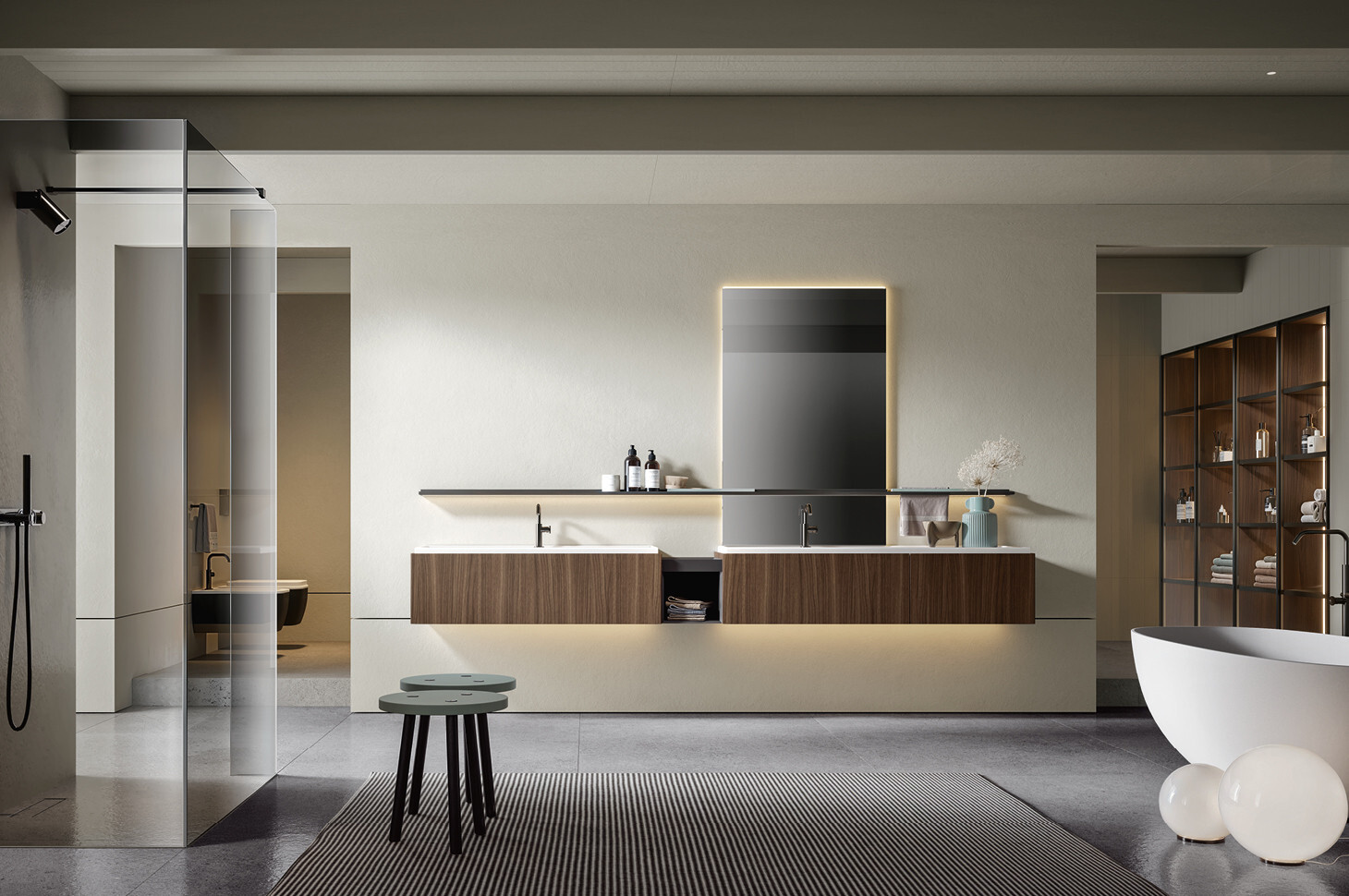
Top with integrated washbasin or countertop washbasin? The choice does not concern only the type of installation, but the way in which the balance of the composition is built. The integrated washbasin works on continuity: basin and top belong to the same design, the furniture reads as a compact volume and the identity of the project comes from the cleanliness of the whole. The countertop washbasin instead introduces an autonomous presence, capable of guiding style through shape, thickness and material.
Recessed solutions, undercounter basins and wash-hand monoblocs complete this range of possibilities, allowing each solution to be calibrated according to proportions, constraints and visual intensity. Because the washbasin does not simply complete the project: it defines its measure.